
Four checks that tell you which key you have
You do not need to know the names. Look at your key and your car, and go through these in order — the first clear answer usually settles it.
- How do you start the car? If the fob stays in your pocket and you press a Start button, it is a smart key. If you slide the whole fob into a slot in the dash and twist it — on a Chrysler, Dodge, Jeep or Ram — it is a FOBIK. If you put a blade in and turn it, go on to the next check.
- What does the blade do? If it folds into the fob and springs out when you press a button, it is a flip key. If it is fixed and always sticks out, keep going.
- Are there buttons, and where? Lock and unlock buttons built into the head of a fixed-blade key make it a remote-head key. Buttons on a separate clicker with no blade at all make that clicker a keyless remote — and the key you drive with is one of the two below.
- How old is the car? A key with no buttons is a transponder (chip) key on most vehicles from about 2000 onward. The chip is sealed inside the head, so you cannot see it. On older vehicles, and some basic models that kept one into the 2000s, it is usually a plain metal key with no chip.
The same checks side by side. Years are a rough guide — two cars of the same year can take different keys depending on the trim.
| Key type | Usual years | How the car starts | Buttons | Blade | Spare from |
|---|---|---|---|---|---|
| Metal key | Older vehicles, mostly before 2000 | Insert and turn — no chip, nothing to program | None | Fixed | $160 |
| Transponder (chip) | Most vehicles from about 2000 | Insert and turn — the car reads the hidden chip first | None | Fixed | $160 |
| Remote-head key | Very common through the 2000s and 2010s | Insert and turn | Lock, unlock, often trunk or panic — on the key head | Fixed, always out | $160 |
| FOBIK | Chrysler, Dodge, Jeep and Ram, roughly 2008–2018 | Slide the whole fob into the dash and twist | 3 to 7 | Small hidden blade slides out of the top | $160 |
| Flip key | Many brands, mostly from the 2000s on | Flip the blade out, insert and turn | On the fob | Folds in, springs out at a button | $160 |
| Smart key | Most newer vehicles, especially mid and higher trims from about 2015 | Keep it in your pocket and press Start | Lock, unlock, sometimes remote start | Hidden inside, slides out | $170 |
| Keyless remote | Early 2000s through the 2010s | It does not — you drive with a separate metal or chip key | Lock, unlock, trunk, panic | None | $160 |
Every key lost, any type: from $200. All prices are all-in, taxes included.
The seven key types, one by one
Match your key to a photo. Each type links to a longer explainer.
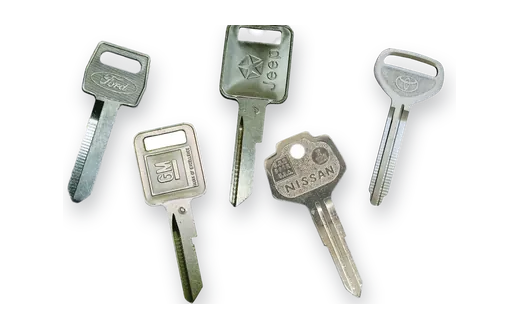
Metal key
A plain cut blade with no electronics inside. It matches your doors and the car purely by its shape, so there is nothing to program — the simplest and most affordable key to make. On many older vehicles I can cut one from the key code or by decoding the lock, even when no key is left.
Spare from $160 · every key lost from $200
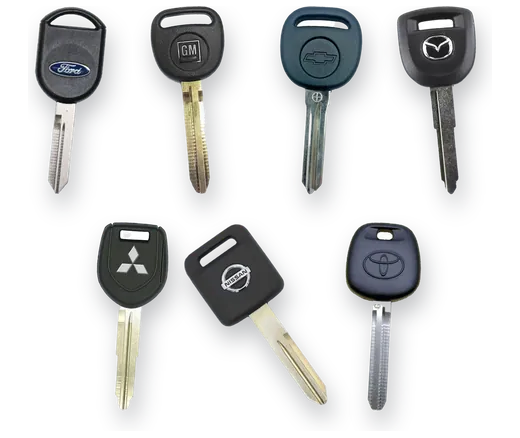
Transponder (chip) key
It looks like an ordinary key, but a tiny chip is sealed inside the plastic head. The chip has no battery: the car reads its code when you turn the key and only starts if it matches. That is why a hardware-store copy may turn but will not start the engine — the chip has to be programmed to your car.
Spare from $160 · every key lost from $200
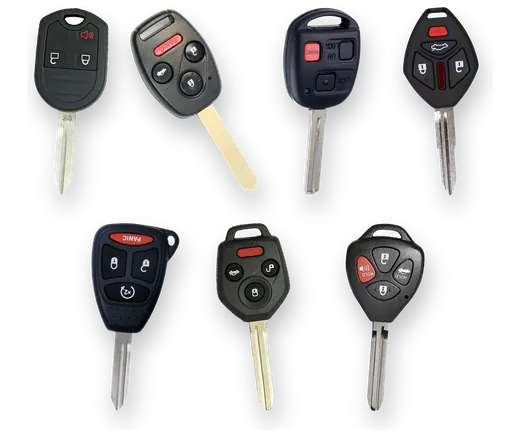
Remote-head key
One solid key with the cut blade, the chip and the lock and unlock buttons all built into the head, and a blade that always sticks out. It starts the car and works as your remote at the same time. If only the buttons quit but the car still starts, it is often just the small battery in the head.
Spare from $160 · every key lost from $200
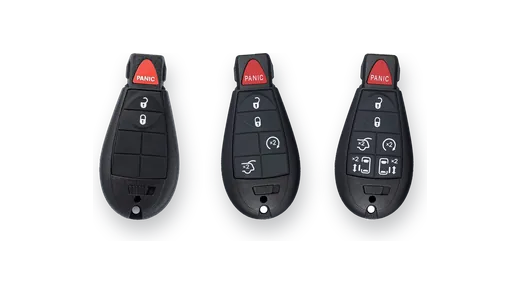
FOBIK
A chunky fob with no blade to turn: you slide the whole fob into a slot in the dash and twist it to start. The buttons, the chip and a small hidden metal blade — for opening the door by hand when a battery is flat — are all in one piece. Almost entirely Chrysler, Dodge, Jeep and Ram from roughly 2008 to 2018, with 3 to 7 buttons.
Spare from $160 · every key lost from $200
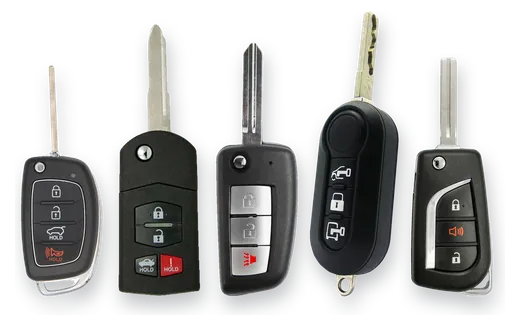
Flip key
The “switchblade” key: press the release and the blade springs out of the fob; fold it back and it disappears. Buttons, chip and folding blade in one unit. The only real difference from a remote-head key is that blade — and the little spring and hinge that flick it out can loosen with years of use.
Spare from $160 · every key lost from $200
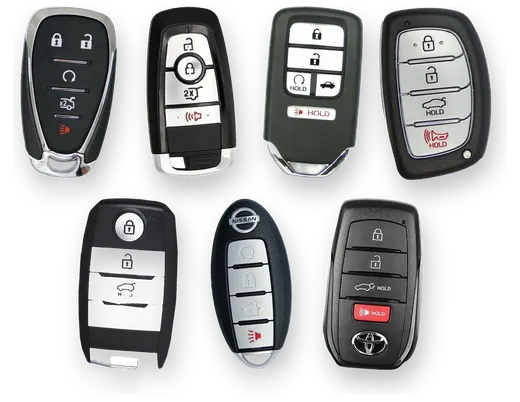
Smart key
The fob stays in your pocket: the car senses it, so you touch the handle to unlock and press Start to drive. There is no blade to turn, though a small metal blade hides inside for opening the door by hand if the battery dies. If Start does nothing, holding the fob right against the Start button often still works on a flat battery.
Spare from $170 · every key lost from $200
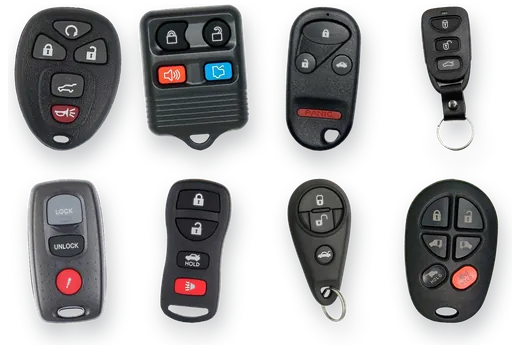
Keyless remote
A separate clicker that locks and unlocks the doors, opens the trunk and sounds the panic alarm from a distance. It will not drive the car: you still need the real metal or chip key, even if the remote can start the engine to warm it up. Weak range or dead buttons usually mean the small coin battery inside.
Remote from $160
What a new key costs
Spare metal, transponder, remote-head, FOBIK or flip key — from $160. A keyless remote is from $160 too.
Spare smart (push-to-start) key — from $170.
Every key lost, any type — from $200.
All-in, taxes included. Some makes cost more, and I tell you the exact number before any work. You pay only once the key works. Full price list
Before any work I check your vehicle registration and a matching photo ID — my standard procedure, to confirm the vehicle is yours.
Frequently asked questions
- How do I tell which car key I have?
- Start with how the car starts. A fob that stays in your pocket while you press a Start button is a smart key, and a fob you slide into a slot in the dash and twist is a FOBIK. If you put a blade in and turn it, look at the blade and the buttons: a blade that folds into the fob is a flip key, buttons on the head of a fixed-blade key make it a remote-head key, and a key with no buttons is a transponder (chip) key on most cars from about 2000 or a plain metal key on older ones. A separate clicker with no blade is a keyless remote.
- Does my car key have a chip in it?
- Probably, if the car is from about 2000 or newer. The chip is sealed inside the plastic head, so you cannot see it, and it has no battery: the car powers it for a moment and reads its code when you start. That is why a plain hardware-store copy may turn but will not start the engine until the chip is programmed to your car.
- What is the difference between a keyless remote and a smart key?
- A keyless remote locks and unlocks the doors, opens the trunk and sounds the alarm, but it will not drive the car. You still need the real key, even if the remote can start the engine to warm it up. A smart key stays in your pocket and lets you drive: the car senses it, you touch the handle to unlock and press Start to go.
- How much does a new car key cost in Winnipeg?
- A spare starts from $160 for a metal, transponder, remote-head, FOBIK or flip key, and a keyless remote also starts from $160. A spare smart (push-to-start) key starts from $170, and if every key is lost it starts from $200 for any type. Prices are all-in with taxes included; some makes cost more, and I tell you the exact number before any work. You pay only once the key works.
- Can I just send you a photo of my key?
- Yes. Send a photo of the key on WhatsApp or Messenger with the year, make and model, and I will tell you which type it is and what it costs. You can message any time; I reply between 8 AM and 9 PM.
Need a new key made?
Mobile auto locksmith — I come to you, 7 days a week.
Save my number to your phone — so it is there next time.